
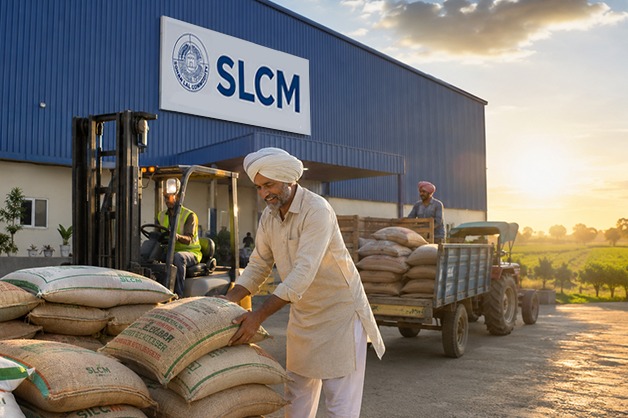
Introduction to Storage in Agriculture
Efficient storage in agriculture is vital for maintaining the quality and quantity of commodities, decreasing losses after harvest, and enhancing the stability of supply chains. Many agricultural commodities continue to experience storage problems that result from inconsistent methods of handling items, inadequate monitoring, and unorganised processes for managing warehouses.
Sohan Lal Commodity Management is one of India’s leading providers of agricultural logistics and warehouse management services. Since 2009, SLCM has been operating a significant warehouse network across India and Myanmar. We provide warehouse management, collateral management, procurement assistance, and agri financing product solutions using technology driven operations.
Major Challenges in Agricultural Storage
Agriculture suffers from numerous issues when it comes to warehouse management such as lack of scientific warehouse management practices. Due to poor handling, exposure to moisture, pest infestation, theft, vandalism and inconsistent monitoring of sites, the quality of commodities in storage and transit is badly affected.
Not having equal access to organized warehouse management services creates inefficiencies in operations for farmers, financial institutions and stakeholders. Many parts of agriculture have limited or no available tools for tracking systems or visibility of the quality of their products. Whenever these inefficiencies continue over time they create declining conditions of commodities, decreased buyer confidence, and financial loss.
The inefficient storage in agriculture force most farmers into selling their commodities sometime immediately following harvest instead of having access to a properly and professionally managed warehouse system.
Impact of Inefficient Storage
Poor storage practices contribute to commodity loss, disrupt the supply chain and create distrust between buyer and lender. Also, the lack of visibility in tracking and proper quality monitoring creates risks throughout the agricultural value chain.
SLCM’s Scientific Storage Approach
SLCM has addressed these issues through the use of a scientific warehouse management system and a standardised operating procedure to manage commodities. SLCM’s scientific storage method employs appropriate methods of handling, stacking, fumigating, managing moisture, conducting inspections, and implementing surveillance systems to ensure the integrity of the commodity remains intact throughout the storage process.
With the technology-enabled warehouse management system, SLCM employs operational visibility, accountability, and decision making can be enhanced in the managed warehouse network. Further, SLCM provides farmers with improved price negotiation power due to better commodity management and market visibility.
Technology-Enabled Storage Management
Modern storage in agriculture relies heavily on technology. In order to improve the accuracy and transparency of its warehouse management operations, SLCM provides instant digital inventory tracking, AI-based quality monitoring tools, automated audit process, and real time reporting systems.
With its patented Agri Reach technologies, SLCM is able to provide a real-time view of all warehouse operations through an integrated system. This also allows for quality checks and operational visibility, thereby eliminating manual errors in the warehouse operations.
Risk and Quality Management
SLCM’s warehouse management practices employ structured risk and quality management solutions. Inspections, pest management, fumigating, moisture control management, audits and monitoring all positively impact the successful management of products and limit risk associated with their operation.
Supporting Collateral Management and Financing
SLCM offers multiple types of collateral management services that allow lenders to use stored commodities as collateral to secure a loan. Verified commodity quality checks, inventory tracking and receipts all help to build confidence and transparency with lenders.
SLCM continues to build upon India’s post-harvest management ecosystem through scientific warehouse management, technology-enabled processes and commodity management programs.
To learn more how SLCM’s scientific processes provide reliable warehousing, agri-logistics and commodity management solutions contact SLCM.
What are the benefits of storing commodities?
Proper storage of commodities helps in maintaining commodity integrity and reducing post-harvest loss.
What are the barriers to good agricultural storage?
Commodity quality can drop due to pest infestation, moisture, theft, improper handling and inadequate monitoring.
How does SLCM service commodity storage operations?
SLCM uses scientific warehouse management systems and technology enabled monitoring processes.
What kind of technologies does SLCM use to manage commodities in a warehouse?
SLCM leverages Agri Reach technology for digital tracking technologies, auditing processes, and AI based quality assurance systems to manage commodities.
How do collateral management services enable securing loans?
Lenders can use stored commodities as collateral on loans.