
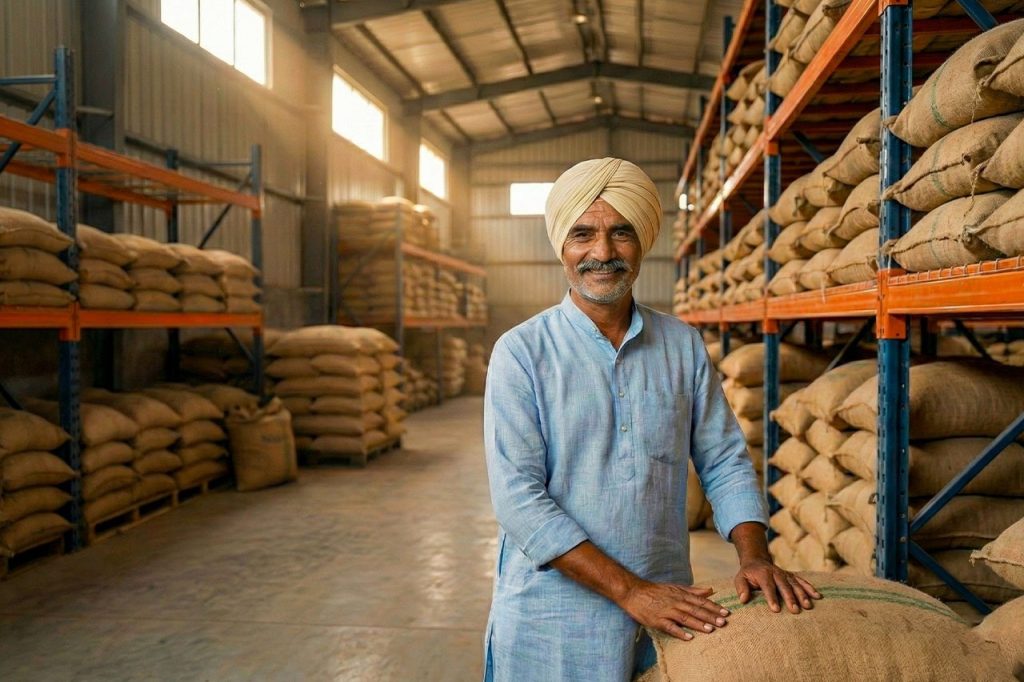
Agriculture is the mainstay of India, but the journey from harvest to market is still complicated, fragmented, and extremely vulnerable to waste. An efficient system needs to be coordinated and technology-enabled. This efficiency is supported by a Phygital approach, where physical processes are enhanced through digital oversight to maintain reliability at every step. This is where agriculture supply chain management comes into play. At SLCM, we have built a singular solution to ensure that commodities flow through storage, processing, financing, and delivery seamlessly and with accountability.
Defining Agriculture Supply Chain Management
Agriculture supply chain management encompasses every activity that links a farm to a consumer, including handling, warehousing, quality inspection, procurement, and collateral management, among others. Each quotation that doesn’t flow creates a loss of value and availability. SLCM plays a critical role throughout the commodity chain, ensuring that it is safe, of high quality, and traceable. With pan-India operations managing over 1200+ different types of commodities in India, we support every agri-stakeholder from farmers to millers, processors, traders, and banks.
Significance of Warehouse Management Companies
Post-harvest wastage remains a critical issue for the agricultural economy. For commodities, without scientific storage and tracking, they will lose market value. Companies managing warehouses like SLCM provide stability for the system through secure and technologically managed storage facilities. SLCM has over 21,000 warehouses in its network (as on October 2025), managing storage capacity greater than 350 million square feet, so at any time across India, we are able to offer consistency with quality and safety throughout.
Real-time tracking, surveillance, and strong operational controls can help maintain the right conditions within the warehouse. Thus, warehouse management companies can support the integrity of the supply chain and reduce the financial risk for producers and buyers.
Quality Assurance and Traceability
The value of any commodity depends on its quality and condition. Warehouse management systems provide transparency and trust in their transactions. SLCM deploys AI powered quality testing in real-time that provide immediate reports and NABL accredited laboratory support to verify the quality of stock stored in their warehouses. This process empowers farmers with price negotiation, provides pricing transparency, market acceptance, and builds greater confidence in the time of producers and buyers in agricultural supply chain management.
Establishing Financial Empowerment with Collateral Management
Agriculture has a critical demand for timely capital, and when crops are properly stored and tracked accurately, they can become a non-volatile source of collateral. SLCM helps to facilitate access to finance through a digitized storage receipt. A storage receipt issued by SLCM serves as verified proof that the commodity is physically present in the warehouse, allowing it to be used as secure collateral for financing. This provides farmers, aggregators, and traders access to the value of their commodities. Our collateral management services are a critical utility in developing the agri-economy and elevating liquidity wherever needed.
A Network That Connects Access and Scale
India’s agricultural markets are vast and diverse in product. Generating seamless execution involves having the retailer geographically covered with clearly defined processes. With operations across 950-plus mandis and a deep regional infrastructure in access and operations, SLCM fulfills proximity and convenience to the agri-retailer ecosystem.
The Role of Technology in Progress
We have innovation in line with the physical. Smart analytics and digital oversight complete risk forecasting, maximize utility, and enable complete visibility. SLCM operates through a Phygital model, combining physical infrastructure with digital intelligence to deliver better speed, accuracy, and traceability across the agri-value chain. SLCM incorporates technology into agri-logistics and finance with a set of professionalism and responsiveness that distinguishes it as unique.
The Role of a Strong Agricultural Supply Chain
Supply chains that support a strong agricultural future are resilient, connected, and inclusive. An effective agriculture supply chain management system enables food security, equitable pricing, waste reduction, and enhanced income opportunities. Sustainability solutions support our endeavor to build systems that optimize productivity, thereby enabling growth for a connected and integrated agriculture value chain. Our expertise, infrastructure, and digital capabilities generate trust from the farm gate to the final buyer.
Final Thoughts
The agricultural ecosystem is dynamic, and so is the outlook from each of the participants. Organizations that seek to understand the complete journey of commodities and provide integrated solutions to drive real value to the agriculture ecosystem must exist. SLCM is the unrivaled leader in India, having demonstrated outcomes, operational excellence, driven by a mission to support, uplift, and empower the agricultural economy in India.
Connect With Us
If you are looking for help in storage, procurement, or logistics with a firm that understands this sector really well, SLCM would love to partner with you. Allow us to bring your supply chain together to make your business grow confidently.