Intoduction
Getting a crop out of the field is only half the job. What happens between harvest and market decides how much a farmer actually earns, and that is where post-harvest management comes in.
One step still slows it down: quality testing. Farmers wait for a manual check of a small sample, often travel and pay to get it tested, and then accept a grade they can’t easily verify. The same lot can be graded differently by two people, which can mean a lower price, a delayed payment and an argument with no proof either way.
AI-powered quality testing changes this. By analysing a photo of the grain sample, it replaces a slow, subjective check with one that is instant, consistent and backed by evidence. In this blog, we’ll look at why quality testing matters in post-harvest management, how AI makes it more reliable, how it works in practice, and who benefits.
The Role of Quality Testing in Post-Harvest Management
Quality assessment is one of the most important checkpoints in the post-harvest journey. Before produce moves from the farm to storage, and again before it is sold, someone has to decide what the lot is actually worth. That grade drives the price, the payment terms, and whether a bank will lend against the stock.
Traditionally, this has been done by hand. Samples are drawn manually, run through sieves, weighed on scales, or sent to a lab. Each step takes time and money, and it often means moving the produce or the sample from one place to another just to get a result.
The bigger issue is subjectivity. Manual grading depends on the person doing it, so the same lot can get different grades from different people. That leaves room for disagreement, and in some cases for middleman bias, where the assessment leans in favour of the party with more power in the deal.
The effects carry down the chain. Delays in grading hold up pricing, which holds up payment, which in turn slows down financing. A check that should be a simple step ends up becoming a bottleneck for farmers, traders, warehouses and lenders alike.
How AI and Machine Learning Are Strengthening Quality Testing in Post-Harvest Management
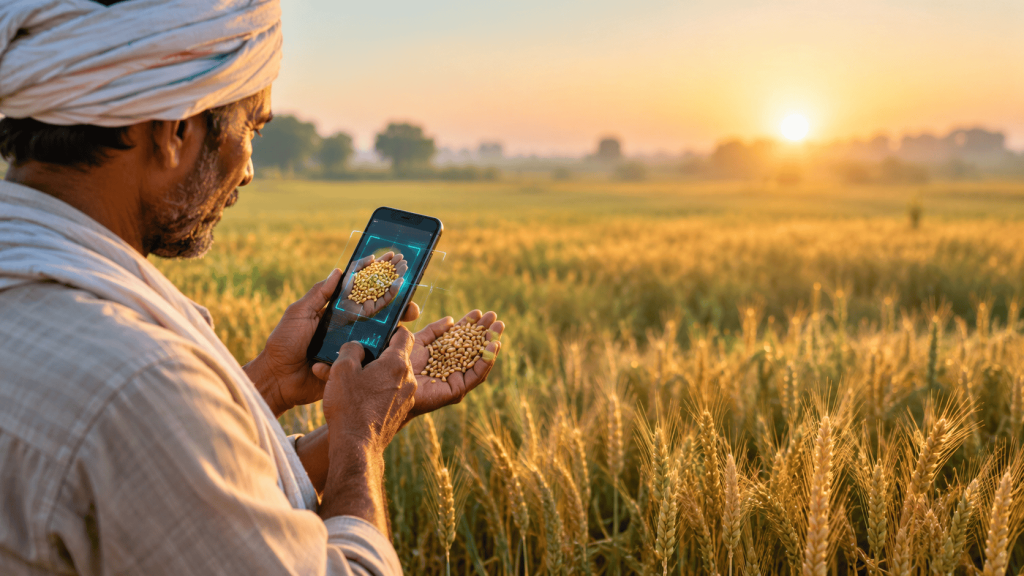
Image-based quality analysis is simpler than it sounds. A photo of the sample is taken, and an AI model studies it the way a trained grader would, but without personal judgement or bias. It looks at each grain in the image, picks out the differences, and turns what it sees into a quality report in real time.
The result is then compared against a large backend dataset of graded samples. Because that dataset keeps growing, the system becomes more accurate over time instead of staying fixed at one level.
This is what makes the difference in post-harvest management:
- Unbiased: The grade no longer depends on who is holding the sample or how they feel that day. The same sample gets the same result every time.
- Faster: What used to take hours or days, including the trip to a lab, is now done in moments.
- Real-time: The report is available the moment the sample is analysed, so decisions on selling, storing or financing can be made right away.
- Empowering for farmers: With an objective report in their own hands, farmers no longer have to depend on someone else’s assessment. They can check their produce for themselves, understand what it is worth and negotiate with confidence.
How the Agri Reach App Brings AI into Post-Harvest Management (Step by Step)
Agri Reach puts this technology in the hands of anyone with a smartphone. Getting a quality report takes three steps:
- Take a photo of the grain sample.
- Submit it in the app.
- Receive an instant quality report in real time.
The report covers the parameters that matter most for grading. For wheat, these are:
- Moisture
- Foreign matter
- Immature and shrivelled grains
- Weevilled grains
- Infestation
- Admixture or other edible grains
- Damaged and discoloured grains
Each report also carries the captured photo next to an annotated version that marks what the AI picked out, so the result can be checked by eye.
There is no special equipment to buy and no technical skill needed. The app is built for regular smartphone users, including farmers in rural India, so a grade that once meant a trip to a lab can now be had on the spot.
The results can also be trusted. Agri Reach holds an NABL certificate for wheat, and it has tested other commodities too, including Rice and Maize.
Why Instant, Transparent Reports Matter for Post-Harvest Decisions
A quality report is only useful if it arrives in time to act on, and if everyone involved can trust it. Instant, photo-backed reports do both.
- Right quality, right price: When the grade is accurate and consistent, the price reflects what the produce is actually worth, so farmers are paid for the quality they grew.
- Evidence that reduces disputes: Every report is tied to a photo of the sample, which gives buyers and sellers a clear record to refer back to instead of arguing over a verbal grade.
- Faster decisions: Farmers can decide where and when to sell, traders can close deals sooner, and warehouses and lenders can move without waiting on a lab result.
- No middleman bias: With an objective report in hand, farmers no longer have to rely on someone else’s assessment. Traders get direct access to verified quality, and farmers gain the confidence to negotiate their price.
Who Benefits from AI-Driven Post-Harvest Quality Testing?
AI-driven quality testing helps everyone along the post-harvest chain:
- Farmers: Get a fair, verifiable grade on the spot, without travel, long waits or reliance on someone else’s judgement.
- Traders: Can buy with confidence, using an objective report to compare lots and close deals faster.
- Aggregators: Can check quality across many small lots quickly and consistently before pooling them.
- Processors: Know what they are sourcing before it arrives, which cuts rejections and wastage.
- Banks and financial institutions: Get photo-backed quality evidence to support lending decisions on stored produce, with lower risk.
What Makes SLCM's Approach to Post-Harvest Management Different
Plenty of tools can analyse an image. What sets SLCM apart is that quality testing is one part of a wider post-harvest system.
Agri Reach is the first mobile app to receive NABL accreditation for quality testing, which means its reports carry credibility that goes beyond a quick estimate.
SLCM follows a phygital approach, combining digital tools with a strong physical presence on the ground. The app doesn’t replace warehouses, people or processes. It makes them more visible, measurable and accountable.
It also sits inside a larger digitised ecosystem that includes warehousing, collateral management and agri financing. Quality, storage, security and financing are connected in one place, so a quality report can feed straight into the next step, whether that’s storing the produce, securing it or raising finance against it.
The Future of AI in Post-Harvest Management
AI-powered quality testing is only the starting point. Here is where post-harvest management is heading:
- More commodities: AI-enabled testing will expand beyond wheat, rice and maize to cover a wider range of crops, so more farmers and traders can use it.
- Connected systems: Integration with IoT, sensors, surveillance and warehouse management systems will link quality data with what is happening inside the warehouse.
- Predictive analytics: Instead of only reporting current quality, systems will flag early signs of deterioration and storage risks, so action can be taken before losses occur.
- Intelligent, real-time management: Together, these steps point toward a post-harvest chain that is monitored in real time and responds to problems as they arise.
The goal stays the same: a post-harvest process that is more transparent, more efficient and fairer to the farmers at its centre.
What is post-harvest management?
Post-harvest management covers everything that happens to a crop between harvest and sale, including quality testing, storage, security and financing. Getting each step right protects the value of the produce and helps farmers earn a fair price.
Why is quality testing important in post-harvest management?
The quality grade decides the price, the payment and whether a lender will finance the stock. Traditional manual checks are slow, costly and subjective, so the same lot can be graded differently by different people. That leads to delays and disputes.
How does AI-powered quality testing work?
A photo of the grain sample is analysed by an AI model, which checks parameters such as damaged, shrunken, shrivelled or immature grains, foreign matter, colour, length and pattern. The results are benchmarked against a backend dataset that keeps improving over time.
Who benefits from AI-driven quality testing?
Farmers get a fair, verifiable grade on the spot. Traders, aggregators and processors can source with confidence, and banks and financial institutions get photo-backed evidence to support lending decisions.
Is AI-based quality testing reliable?
It can be. NABL-certified testing is available for wheat, and other commodities such as rice and maize have also been tested. Every report is backed by a photo of the sample, which gives buyers, sellers and lenders a clear record to rely on.