
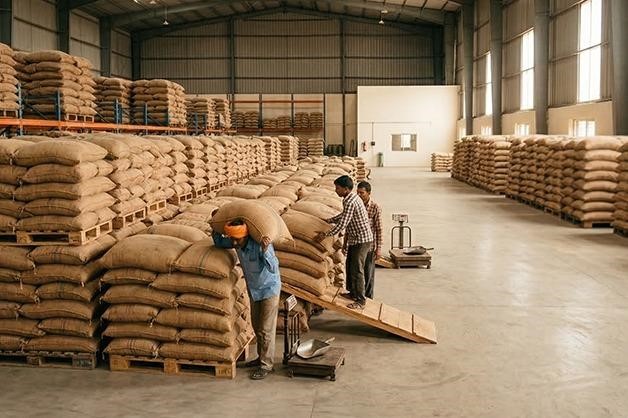
The true test of an agricultural season’s worth often comes after the harvest. For those in the business, the real work starts when the crops are off the field. It is in the space between harvest and the final sale that most of the value disappears—not just in sheer quantity, but also in quality and what the market will pay. SLCM has taken on this challenge by reimagining warehouse storage. We view it not as a simple storage area, but as a dynamic, scientific system designed to keep agricultural products safe from the unpredictable forces of nature and the market.
1. Protecting Agricultural Value Beyond Harvest: Why Storage Matters
In a traditional setup, the lack of proper post-harvest management creates a massive economic drain. When harvests all come in simultaneously, the market becomes saturated. Prices plummet, and those involved frequently have to resort to “distress sales” to prevent their goods from going bad. SLCM’s strategy changes the supply chain’s primary goal from simply “how much is made” to “how much value is maintained.”
By providing secure warehouse storage, we allow farmers, traders, and processors to wait for the right market conditions, directly improving ROI through better market timing. These facilities function as a regulatory bridge for the agricultural economy, absorbing the surplus during the harvest peak and releasing a steady, high-quality supply as needed, which is the only way to ensure true food security and supply chain resilience.
2. From Infrastructure to Intelligence: The Shift Towards Scientific Warehousing
For too long, warehousing was defined by the quality of the “godown” or the physical building. SLCM has moved beyond this with “Agnostic Excellence.” Our systems for warehouse storage are built to function independently of any specific infrastructure. We employ scientific optimization techniques that are effective no matter the underlying physical setup or location.
As of February 2026, this “Process-First” philosophy is active across more than 21,000 locations in India and Myanmar. We’ve replaced the four-walls-and-a-roof mentality with a strict regime of SOP-driven management. In this 2026 paradigm, the “intelligence” provided by real-time data and rigorous audits has completely replaced the “intuition” and guesswork that used to dominate traditional warehousing.
3. Managing Commodity Diversity: Storage Solutions Across Crops and Regions
Managing the wide array of agricultural produce is a complex task. A single warehouse storage solution simply won’t work. Each crop has its own unique biological clock and breathing pattern. SLCM currently oversees more than 1,600 distinct agro-commodities, and each is handled according to a specialized protocol. These protocols are designed to accommodate the specific shelf-life and sensitivity of each individual product.
This expertise extends to regional adaptability. Managing over 350 million sq. ft. of area means our processes must be calibrated for the diverse climatic zones found across 22+ Indian states and Myanmar’s industrial zones. Whether it is the humid air of a coastal region or the dry heat of the plains, our logic-based scalability ensures a uniform quality standard across every single square foot of warehouse storage we manage.
4. Risk Mitigation in Agricultural Storage: Controlling Moisture, Pests, and Quality Loss
Post-harvest losses, frequently estimated at 30% to 40%, are substantially caused by “Invisible Enemies” like pests, fungi, and fluctuating humidity levels within traditional warehouse storage methods. Our approach proposes a shift from reactive to proactive strategies, prioritizing preventative measures rather than corrective actions.
Our strategy involves a constant cycle of scheduled aeration, mechanical cleaning, and high-precision moisture mapping. This isn’t just about keeping the insects away; it’s about a “Zero-Loss Ambition.” We use scientific monitoring to ensure that the Grade-A specifications and the original nutritional integrity of the produce are exactly the same at the time of withdrawal as they were at the moment of deposit.
5. Cold Storage Management for High-Value Horticulture Produce
The horticulture sector faces the steepest challenges because fruits and vegetables are living, breathing products that perish rapidly. SLCM is driving a “Cold Chain Revolution” by managing more than 90 cold storages with a specific focus on cutting down the waste that usually plagues this sector.
We utilize IoT-enabled Digital Twins and Predictive Thermal Mapping to monitor every corner of these facilities 24/7. This allows us to identify and eliminate “hot spots” within the warehouse storage area before they can ruin a batch. This level of environmental control adds significant days, and sometimes weeks, to the marketability of perishable goods. For a trader, that extra time is the difference between a profitable season and a total loss.
SLCM’s scientific storage preserves crop quality over time, allowing stakeholders to avoid selling during harvest gluts and wait for better market prices, which significantly improves their total ROI.
It means our scientific processes and SOPs work in any building. We focus on process intelligence and data rather than the physical structure to maintain uniform storage standards everywhere.
We apply specialized protocols for over 1,600 commodities. Each plan accounts for a crop’s unique respiration rate and shelf-life, ensuring the specific biological needs of every product are met.
It is our commitment to maintain the exact nutritional integrity and Grade-A specifications of produce from deposit to withdrawal through preventative aeration, cleaning, and constant moisture mapping.
By using IoT-enabled Digital Twins, we monitor facilities 24/7 to detect and eliminate "hot spots." This precision prevents batch spoilage and extends the marketability of perishable horticulture goods.
While yield provides quantity, post-harvest management ensures "value preservation." Without scientific storage, 30–40% of produce is lost to pests and moisture, rendering the initial harvest efforts economically ineffective.