
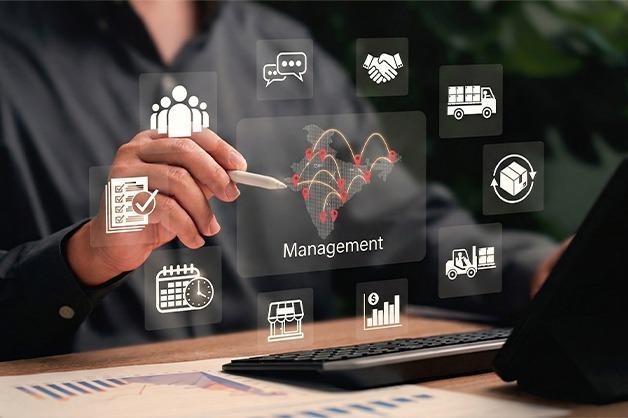
As India’s largest one-stop post-harvest Agri-logistics platform, Sohan Lal Commodity Management Ltd. has grown by staying focused on what truly matters in agriculture; reliability, discipline, and continuous improvement. Over the years, we have built a phygitally connected agri value chain that brings scientific warehousing, food grain protection, pest management, NABL-accredited quality testing, certification, and collateral-backed financing together in a practical and well-coordinated manner.
Our Phygital model simply means that strong, on-ground infrastructure is supported by intelligent digital systems working quietly in the background. Through this approach, SLCM provides structured and transparent commodity management services to farmers, traders, processors, financial institutions, exchanges, and government bodies. From the time a commodity is stored to the time it moves out, every stage is transparent and carefully monitored. This practical, technology-enabled approach brings clarity, strengthens trust, and ensures stakeholders always have complete visibility into every stage.
Phygital Integration across the Value Chain
We have built an ecosystem where procurement, trading, warehousing, collateral management, and agri-financing operate on a single, connected platform. Powered by SAP-enabled warehouse management systems, AI and ML-based quality check applications, automated audits, and centralized monitoring, the Phygital framework keeps every part of the operation connected. Instead of teams working in isolation, information moves smoothly across functions, making day-to-day coordination easier and more reliable.
This connected system helps teams decide faster, work with better clarity, and grow into new regions without losing control of operations. SLCM’s commodity management services deliver efficiency that stakeholders can genuinely see and rely on by bringing together real-time insights and disciplined on-ground processes.
Smart Warehousing and Real-Time Monitoring
Our approach to warehousing is a structured, tech-savvy way of protecting commodities scientifically. We provide 24/7 real-time CCTV monitoring of commodities through the state-of-the-art Agri Suraksha, using centrally located solar powered 4G SIM-based cameras and GPS-enabled electronic locks to prevent unauthorized entry into the warehouse. As a result of our automated audit applications and real-time reports, we are able to initiate immediate action against any suspicious activity while achieving operational excellence, security and accuracy at all our warehouses across the country.
AI-Driven Quality Checks and Digital Operational Tools
At SLCM, , quality control is powered by Agri Reach, an AI/ML-powered quality check application, the first of its kind in the industry to scientifically deliver instant report on the quality of commodities. By scanning and uploading a picture of the commodity in Agri Reach through a smart-phone, it generates a fully transparent and auditable report promptly. As of 31 January 2026, a total of 3,46,865 inspections have been conducted in 22 provinces covering 102 different types of commodities with an overall volume of 17.75 million metric tons. A centralized database records both real-time and consolidated inspection data. Combined with centralized monitoring, this system supports effective quality control and helps maintain consistent quality standards across the warehouse network.
Phygital Warehousing Model
The Phygital warehousing model, blends both physical infrastructure and advanced digital monitoring, to establish a single agricultural value chain.The model is supported by patented systems that enable real-time data management and real-time monitoring of quality control data within the warehouse management system. Integrated with SAP-enabled operations, automated audit applications, and 24×7×365 surveillance, this technology framework supports structured processes and transparent reporting across 21,000+ warehouses in India and Myanmar. By having a combination of an SOP and risk-based monitoring, the model is agnostic to geography, infrastructure, crop, or climate, allowing for rapid growth while maintaining consistent standards.
Technology-Enabled Collateral Management and Financing
Our collateral management solution uses process as well as technology to allow stored commodities to be used as reliable security for a loan. After a commodity is stored, a storage receipt is issued and the attribute of quantity and quality is effectively managed by a combination of real-time measurement and monitoring, automated assessments, along with facilities for centralizing surveillance of both the commodity and the storage locations. This transparent process allows banks or financial institutions to have confidence in providing financing because the commodity will be monitored continuously and will be available to be liquidated as needed. By providing both disciplined warehousing procedures and constant monitoring of a commodity, we build trust among all parties involved in the supply chain, including lenders, traders, processors and the larger commodity-related sector.
Scientific Testing and Quality Assurance
Our quality standards are based on scientific methods. We test commodities for quality at our NABL-accredited analytical laboratories using standards that assure consistent and precise testing without exception. Each of our SOP defines how quantity and quality will be evaluated through defined processes, visits to storage facilities, and using composite control samples for periodic quality assurance of tested commodities. Regular maintenance, fumigation, etc., help to ensure the health of stored commodities, as well as that uniform quality standards are achieved during transportation and storage.
Future Outlook: Technology-Led Commodity Ecosystem
The digitization of logistics will continue to enhance the flow of commodity logistics through phygitally integrated agri value chain linked with real-time data, AI/ML-driven quality systems, centralized control systems and automated audits. All of the various means of creating transparency in the agri commodity ecosystem will be aided by SLCM’s patented monitoring systems and integrated digital platforms. We continue to create a technology-based, transparent and efficient, commodities based ecosystem via structured policies, concurrent monitoring for compliance and scalable infrastructure across multiple geographies.
Use Technology to Strengthen Your Commodity Strategy
Work with SLCM in order to utilize structured warehousing, real-time monitoring, an AI-based quality evaluation, and technology-based collateral management to support a secure, transparent, scalable and disciplined commodity ecosystem driven by robust digital infrastructure.